

Key takeaways
- The best toddler beds keep a 2 to 5 year old safe at night with low frames, guardrails and a snug crib-mattress fit. We compare five picks for every room.
The real decision is not which bed looks cutest in the nursery. It is whether the bed keeps a wiggly 2 to 5 year old safe through the night while letting them climb in and out alone. A bed that is too high, too light, or missing guardrails turns bedtime into a fall risk, while a bed built around a standard crib mattress, with low rails and certified materials, makes the crib-to-bed transition boring in the best possible way.
This guide is for parents moving a toddler out of the crib, grandparents setting up a spare room, and anyone furnishing a small nursery where a twin bed would swallow the floor. The five beds below were chosen from names and specs on the Amazon product page — frame materials, dimensions, weight limits and safety certifications — covering wood classics, a character bed, and a floor bed for older toddlers.
Quick Picks
As an Amazon Associate we earn from qualifying purchases
| Product | Best for | Key spec from title |
|---|---|---|
| Delta Children Wood Sleigh Toddler Bed | A classic first big-kid bed that reuses the crib mattress | Solid wood sleigh frame, Greenguard Gold Certified |
| Dream On Me Classic Design Toddler Bed | The lightest, simplest wood transition bed | Solid pine frame with arched headboard |
| Delta Children CoComelon Plastic Toddler Bed | A bedtime-resistant toddler who needs a favorite character | Steel frame with CoComelon character panels |
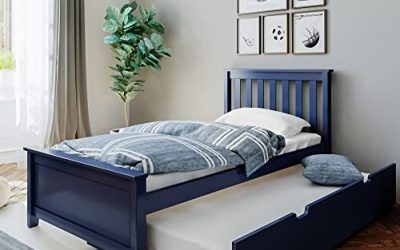
| GAP GapKids Toddler Bed | A styled nursery where the bed should look like furniture | Two-tone navy and natural wood frame |
| Costzon Twin Floor Bed Frame | An older toddler moving straight to a twin mattress | Twin floor bed with 210D Oxford cloth mat |
How to Choose
Guardrails and low height
The first thing to check is how far your child can fall and what stops them. A toddler bed should sit low enough that a child can climb in and out without help — most of the beds here sit under 30 inches high — and it should have guardrails on both sides that stay attached. Rails that run most of the length of the mattress matter more than decorative headboards, because a sleeping toddler rolls sideways, not toward the foot. If the bed is light, check that the rails are bolted on rather than slotted in, since a rail that pops loose under a climbing child is worse than no rail at all.
Mattress size and fit
Four of the five beds here take a standard crib mattress, and that is the single biggest money saver in this category: the mattress, sheets and waterproof pad from the crib transfer straight over. The catch is fit. A mattress that is too short or too narrow leaves a gap at the rails where a small arm or leg can get trapped, so measure the inside of the frame and compare it with the mattress before the first night. The fifth bed takes a twin mattress, which suits an older toddler but means buying a new mattress and bedding. Decide which size you are buying before you fall for a frame.
Frame material and weight limit
Wood, steel-and-plastic and upholstered frames all work, but they fail in different ways. Solid wood beds are the heaviest and the most stable, and they survive being handed down to a sibling. Steel-and-plastic beds are lighter and easier to move, but check the joints: a wobbly frame at assembly will only get looser. Upholstered floor beds trade height for a padded landing. Whatever the material, the weight limit is almost always 50 pounds, which most children reach between ages 4 and 5 — so a toddler bed is a two-to-three-year purchase, not a bed for the whole childhood.
Where cheap toddler beds cut corners
The cheapest beds in this category usually cut the same three things: certification, hardware and finish. A bed without JPMA certification or Greenguard Gold testing may still be safe, but you have no independent check on its materials or emissions, and the saving is rarely worth it. Thin bolts and plastic connectors are the next giveaway — they loosen within months on a bed a toddler climbs daily. And a finish that is not lead and phthalate safe matters more on a bed than on a bookshelf, because toddlers chew headboards. Pay for the certification and the hardware; save money on the theme instead.
The 5 Best Options
Delta Children Wood Sleigh Toddler Bed

The sleigh silhouette is the reason this bed keeps showing up in nurseries: a curved headboard and footboard, a white finish that suits almost any bedding, and a frame built from New Zealand pine, poplar and TSCA-compliant engineered wood. Two attached guardrails and a low profile let a 15-month-old climb in without a boost, and the Greenguard Gold certification means the finish was tested for more than 10,000 chemicals and VOCs. It takes a standard crib mattress, so the mattress and sheets from the crib move straight over. Budget pick for parents who want furniture that looks deliberate rather than temporary.
Specs
- Frame: New Zealand pine, poplar and TSCA-compliant engineered wood
- Dimensions: 56.75 inches long x 30 inches wide x 27.5 inches high
- Weight limit: 50 pounds; recommended for ages 15 months and up
- Guardrails: two attached guardrails
- Certifications: JPMA certified; meets or exceeds CPSC and ASTM standards; Greenguard Gold Certified
- Finish: non-toxic multi-step paint process, lead and phthalate safe
- Mattress: fits a standard crib mattress, sold separately
- Also available in Grey and Dark Chocolate
Best for: A first big-kid bed in a nursery that should still look like a nursery.
Watch out for: The mattress is sold separately, and it must be a standard crib mattress no thicker than 5.75 inches, or gaps can form at the rails.
Dream On Me Classic Design Toddler Bed
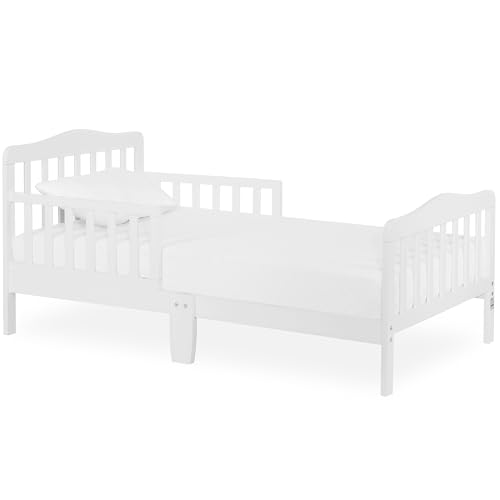
At 16.5 pounds, this is the lightest wood bed here, which matters when you are the one carrying it upstairs and assembling it solo — tools and instructions come in the box. The solid pine frame has a gently arched headboard and footboard, two side safety rails and a reinforced center leg that keeps the frame steady when a toddler bounces on it. The finish is Greenguard Gold certified, and the frame is free of phthalates, latex, lead and BPA. It fits a standard crib or toddler mattress, so the crib bedding transfers over without a new shopping list. Budget pick for a straightforward, no-fuss transition bed.
Specs
- Frame: solid pine wood with arched headboard and footboard
- Dimensions: 53 inches long x 28 inches wide x 30 inches high; weighs 16.5 pounds
- Weight limit: supports children up to 50 pounds
- Safety rails: two side safety rails plus a reinforced center leg
- Certifications: JPMA certified; meets or exceeds ASTM and CPSC standards; Greenguard Gold certified finish
- Materials: free of phthalates, latex, lead and BPA
- Mattress: compatible with a standard crib or toddler mattress, sold separately
- Assembly: tools and instructions included
Best for: Parents who want the lightest, simplest wood transition bed.
Watch out for: At 16.5 pounds it is light enough to shift on slick floors, so check the legs sit flat and the frame does not slide when your child climbs in.
Delta Children CoComelon Plastic Toddler Bed

Some toddlers will not stay in a plain bed, and that is exactly the problem this one solves. The CoComelon graphics turn the headboard into a familiar face, which is often the difference between a child who climbs out every ten minutes and one who settles. Under the character panels sits a sturdy steel frame with high-quality plastic, two attached guardrails and a low profile sized for a standard crib mattress. It is JPMA certified to ASTM standards and rated for ages 15 months and up to 50 pounds. Budget pick for a child who needs a reason to love bedtime.
Specs
- Frame: sturdy steel frame with high-quality plastic construction
- Dimensions: 53.94 inches long x 29.13 inches wide x 26.18 inches high
- Weight limit: holds up to 50 pounds; recommended for ages 15 months and up
- Guardrails: two attached guardrails, low to the ground
- Certification: JPMA certified to meet or exceed ASTM safety standards
- Mattress: uses a standard crib mattress, sold separately
- Design: CoComelon character headboard and footboard
Best for: A toddler who resists bedtime and lights up for a favorite character.
Watch out for: Character beds date fast — a child who loves CoComelon at two may be over it at four, while the 50-pound limit still applies.
GAP GapKids Toddler Bed

This is the bed for a room where the furniture is supposed to look considered. The two-tone navy and natural wood finish reads like a piece from the GapKids collection rather than a stopgap, and it coordinates with the rest of that line if you are furnishing a whole room. The build is serious underneath the styling: a sturdy wood frame, two attached guardrails, a low profile, JPMA certification and a Greenguard Gold finish tested for more than 10,000 chemicals and VOCs. It fits a full-size crib mattress and holds up to 50 pounds. Mid-range pick for a nursery that doubles as a designed space.
Specs
- Frame: sturdy wood toddler bed with modern two-tone navy and natural design
- Dimensions: 29 inches wide x 53 inches deep x 23.5 inches high
- Weight limit: holds up to 50 pounds; recommended for ages 15 months and up
- Guardrails: two attached guardrails, low to the ground
- Certifications: JPMA certified to meet or exceed CPSC and ASTM standards; Greenguard Gold Certified
- Finish: non-toxic multi-step painting process, lead and phthalate safe
- Mattress: fits a full-size crib mattress, sold separately
- Collection: coordinates with GapKids by Delta Children items
Best for: A styled nursery or shared bedroom where the bed needs to look like real furniture.
Watch out for: The two-tone finish is the point of this bed, so confirm the navy and natural tones suit the room before ordering — the mattress is sold separately.
Costzon Twin Floor Bed Frame

This is the only bed here built around a twin mattress. Sitting 5.5 inches off the floor with an upholstered headboard, padded boards and a 210D Oxford cloth mat underneath, it follows the Montessori floor-bed idea: the child can get in and out alone, and a roll out of bed is a short drop onto a mat. The frame fits a standard twin mattress between 6 and 7.8 inches thick, with elevated side boards holding it in place and a wide poplar middle support slat underneath. ASTM and CPSIA compliant, it is aimed at ages 3 and up. Premium pick for an older toddler ready for a real twin bed.
Specs
- Frame: upholstered floor bed frame with 20D sponge-padded headboard and water-resistant PVC upholstery
- Dimensions: 80.5 inches long x 42 inches wide x 30 inches high; sits 5.5 inches off the ground
- Mattress: fits a standard twin mattress 6 to 7.8 inches thick, not included
- Base: 210D Oxford cloth floor mat attached beneath; wide poplar wood middle support slat
- Safety: elevated side boards and footboards keep the mattress in place; ASTM and CPSIA compliant
- Age: ideal for boys and girls above the age of 3
- Design: pastel unicorn, star and rainbow pattern
Best for: A 3-year-old moving straight to a twin mattress in a Montessori-style room.
Watch out for: Measure first — at 80.5 inches long it needs a full twin footprint, and it is designed for ages 3 and up, not for a 2-year-old fresh out of the crib.
Which One Fits Your Situation
Moving a 2-year-old out of the crib on a budget
Pick the Dream On Me Classic or the Delta Children Sleigh. Both take the standard crib mattress your child already sleeps on, both have two guardrails and JPMA certification, and both cost less than buying a new mattress setup. The Dream On Me is lighter and easier to assemble alone; the Sleigh looks better and weighs more, so it stays put on hard floors.
A child who will not stay in bed
Pick the CoComelon plastic bed. A favorite character on the headboard is the cheapest bedtime leverage there is, and the steel frame, guardrails and crib-mattress fit are the same safety basics as the wood beds. Accept that the theme will age out before the frame does, and plan on the next bed around age four or five.
A nursery that should look designed
Pick the GAP GapKids bed. The navy and natural two-tone finish coordinates with the rest of the GapKids line, so the bed reads as furniture rather than a placeholder. It keeps the same guardrails, 50-pound limit and crib-mattress fit as the budget wood beds, with a Greenguard Gold finish on top.
An older toddler ready for a twin mattress
Pick the Costzon floor bed. At 3 and up, a child who can climb in and out alone does not need crib rails — they need a low twin bed that cannot drop them far. The 5.5-inch height, padded headboard and Oxford cloth mat make it a Montessori-style setup, but measure the room first: it needs a full twin footprint.
Common Mistakes
- Buying the mattress before the bed, then discovering the frame takes the other size — crib and twin mattresses are not interchangeable.
- Using a mattress thicker than the guardrails allow, which turns the rails into decoration, or a mattress so thin it leaves a gap at the frame edge.
- Skipping JPMA certification and Greenguard Gold testing to save a little, then wondering what the finish is made of when your toddler chews the headboard.
- Ignoring the 50-pound weight limit and the 15-month minimum age — toddler beds are built for a narrow window, and an older child needs a twin bed.
- Forgetting the mattress is sold separately on every bed here, and budgeting only for the frame.
Frequently Asked Questions
What size mattress does a toddler bed use?
Most toddler beds, including four of the five here, use a standard crib mattress — about 52 inches long and 28 inches wide. That is why the crib-to-bed transition is cheap: the mattress and sheets move over. Floor beds and junior beds built for older toddlers may take a twin mattress instead, so check the frame’s listed mattress size before ordering.
What age should a child move to a toddler bed?
Most manufacturers recommend 15 months as the minimum, and most families make the move between 2 and 3, usually when the child starts climbing out of the crib. A child who sleeps happily in the crib does not need to move early. Once the child can climb out, the crib becomes the unsafe option, and a low bed with guardrails is the safer next step.
Are guardrails necessary on a toddler bed?
Yes for a child under 3, and useful up to 5. Toddlers roll in their sleep, and a low bed still drops a child onto a hard floor. Two attached guardrails that run most of the mattress length stop the common sideways roll. Rails are not a substitute for a low frame, though — a high bed with rails still hurts when a child climbs over them.
How long will a toddler bed last?
Plan on two to three years. The 50-pound weight limit on most toddler beds is reached around age 4 or 5, and a tall 4-year-old will outgrow a crib-size mattress before that. A twin floor bed lasts longer because the mattress is full size, but the frame is still sized for a young child. Budget for the next bed, a twin, from the start.
More from Amazon
Programs that pair well with the guide above. Offers and eligibility are set by Amazon and may change.
Set up recurring deliveries of everyday items on eligible products. Terms and savings are set by Amazon.
Explore Subscribe & SaveCollect the home and kitchen items you want in one registry that guests can shop from.
Create a wedding registryFree shipping on eligible items, Prime Video and more. Eligible new members can start with a free trial.
Start a Prime free trialAudiobooks and podcasts to listen to on the go. Eligible new members can start with a free trial.
Try Audible freeAs an Amazon Associate we earn from qualifying purchases.




Write Your Review
No reviews yet. Be the first to share your experience!