

Key takeaways
- Three ankle braces for soccer compared across rigid, lace-up and sleeve designs, with cleat fit, sizing and support-level checks to run before ordering.
Soccer loads the ankle in ways few sports match: planted-foot tackles, sharp cuts on wet grass and landing on an opponent’s boot all roll the joint inward. The real decision is not whether a brace helps, but how much structure your ankle needs weighed against how much bulk your cleats can swallow. A rigid shell controls a loose ankle but changes how the boot feels, while a thin sleeve disappears inside the shoe yet only steadies a healthy joint.
This roundup covers three groups: players protecting an ankle that has already rolled more than once, players who want tape-style support without a trainer’s table, and healthy players who want light protection that stays invisible under a sock. The picks come from the product names and specifications published on the Amazon product pages, so the comparison rests on stated support structures, sizing methods and materials rather than on marketing claims.
Quick Picks
As an Amazon Associate we earn from qualifying purchases.
| Product | Best for | Key spec from title |
|---|---|---|
| Cramer Active Ankle T2 Ankle Brace | Recurrent sprains needing rigid control | Rigid U-shaped shell with bilateral hinge |
| Active Ankle AS1 Pro Lace Up Ankle Brace | Tape-style support in low-cut boots | Low-profile lace-up with figure-8 straps |
| adidas Performance Climacool Ankle Support | Healthy ankles wanting light protection | Aeroready compression knit with kinesiology band |
How to Choose
Match the Support Structure to Your Ankle History
Start with your own history, because it decides how much hardware you need. An ankle that has rolled repeatedly loses some of its position sense, and a rigid or semi-rigid brace with a hinge or molded shell gives that joint mechanical limits it no longer provides itself. A first mild sprain usually needs a lace-up with straps once swelling settles, since the straps reproduce a tape job and can be tightened as the ankle changes. Healthy ankles need the least: a compression sleeve adds warmth and feedback without restricting the push-off and striking motions soccer depends on.
Check the Fit Inside Your Cleats
Soccer boots are cut lower and tighter than court shoes, so a brace that fits a basketball shoe may never seat properly in a cleat. Put the brace on over your match sock, lace the boot fully, and check three things: the heel sits all the way back, the collar does not fold the brace’s top edge, and you can still point the toes for a strike. Thin designs slide under knit uppers, while rigid shells may need a boot with a wider opening. If you are between fits, choose the brace first and size the boot around it.
Size From the Maker’s Chart, Not Your Shoe Size Alone
Ankle brace sizing is not standardized. Some brands size by shoe size ranges, others by the circumference around the ankle bones or even around the heel, and the same player can land in different sizes across brands. Measure the way the listing’s chart asks, with the tape snug but not digging in, and measure both ankles if one is still slightly swollen. If your number falls on a boundary, follow the maker’s own tie-break advice where the listing gives it, and remember that a brace sized for a swollen ankle will loosen as the swelling goes down.
Plan for Sweat, Washing and Rotation
A brace worn for training and matches soaks up sweat every session, and most of the designs in this roundup are hand wash only, so drying time becomes part of the decision. A brace that is still damp at the next session gets left at home, which is why regular players often keep two and rotate them. Check the care line on the listing before you order, note whether straps and shells can be rinsed quickly, and budget for the second brace if you train more than twice a week. Rotation also spreads wear on straps and hook-and-loop closures.
The 3 Best Options
Cramer Active Ankle T2 Ankle Brace
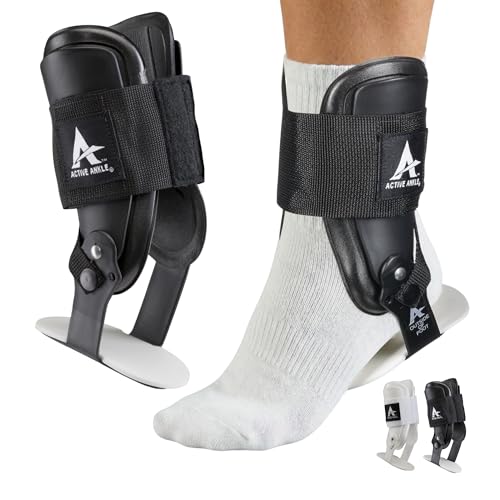
The T2 is the maximum-structure option here: a rigid U-shaped shell with a bilateral hinge that limits side-to-side roll while still letting the ankle hinge forward for running and striking. That makes it the natural pick for a player whose ankle has rolled repeatedly and who no longer trusts tape alone. The EVA padding softens contact with the ankle bones, the single strap adjusts without removing the boot, and the same brace fits either foot, which simplifies ordering for a pair. It is the bulkiest design in this roundup, so cleat fit needs checking first.
Specs
- Brand: Cramer
- Model number: 277517
- Listed size: Medium (title sizing: men’s shoe sizes 7-10, women’s 8-11)
- Color: Black
- Construction: Rigid U-shaped shell with anatomical bilateral hinge
- Padding: Lightweight EVA padding
- Fit: Left or right foot
- Protection level listed: High, dual rigid design
- Material: Polyester
- Item weight: 0.12 kilograms
- Item dimensions: 3 x 5 x 9 inches
- Care: Hand wash only
Best for: Players with a history of repeated rolls who need rigid side-to-side control in training and matches.
Watch out for: It is the bulkiest pick here, so confirm your cleats close over it before match day, and note the listed size is keyed to shoe-size ranges rather than an ankle measurement.
Active Ankle AS1 Pro Lace Up Ankle Brace

The AS1 Pro is the tape-job alternative: a lace-up body with figure-8 straps that cross under the heel and lock the ankle the way a trainer’s taping does, in a lower profile than the rigid T2. Speed-lacing eyelets make it quicker to put on before training, and the non-slip print on the sole helps it stay put inside the boot instead of creeping down the heel. It suits players with a mild sprain history who want real strap support but still need to feel the ball through a thin boot upper.
Specs
- Brand: Cramer
- Model number: 760271
- Listed size: Small
- Color: White
- Closure type: Lace-Up
- Design: Lace-up brace with straps, non-slip sole print
- Protection level listed: Medium
- Item dimensions: 2.25 x 9.75 x 6 inches
- Item weight: not stated
- Care: Hand wash only
Best for: Players with a mild sprain history who want tape-style strap support that stays low-profile inside knit boots.
Watch out for: This listing is the White in size Small; the same model is sold in other sizes and in Black, so confirm the exact variant on the listing before ordering.
adidas Performance Climacool Ankle Support

The adidas support is the lightest route: a pull-on compression knit that adds warmth and joint feedback with almost no bulk, so it disappears inside low-cut knit boots and under a match sock. An integrated kinesiology band runs down the heel for structure, and a silicone grip helps the sleeve stay in place through a full session. It will not mechanically stop a roll, so it belongs on healthy or nearly recovered ankles that want reassurance in training rather than on a joint that still gives way in matches.
Specs
- Brand: adidas
- Model number: ADSU-13311
- Listed size: Small (sizes listed from S to XL)
- Color: Grey
- Design: Pull-on compression knit sleeve with integrated kinesiology band
- Features listed: Aeroready moisture management, silicone grip
- Item dimensions: 0.12 x 3.74 x 7.6 inches
- Item weight: 0.96 ounces
- Material: not stated
Best for: Healthy ankles that want light compression and feedback without changing how their cleats fit.
Watch out for: A knit sleeve does not mechanically limit a roll, so it is not a return-from-sprain brace on its own; step up to a strapped or rigid design if the ankle still feels loose.
Which One Fits Your Situation
Your Ankle Has Rolled More Than Once
Repeated rolls mean the joint needs mechanical limits, not just compression. Start with the Cramer Active Ankle T2: its hinged rigid shell controls side-to-side movement while preserving the forward hinge you need to run and strike. Wear it in training as well as matches, and step down to a lace-up only when the ankle has stayed stable through several weeks of full sessions.
You Want Support Without Losing Ball Feel
Choose the Active Ankle AS1 Pro. Its lace-up body and figure-8 straps reproduce the hold of a tape job at a lower profile than a rigid shell, so the boot upper stays close to the foot and first touch feels closer to normal. The non-slip sole print matters here: a brace that migrates inside the boot quickly becomes more distraction than support.
Your Ankles Are Healthy and You Play Often
Pick the adidas Performance Climacool support. As a thin compression knit with a kinesiology band and silicone grip, it adds warmth and feedback without changing how your boots fit, which suits healthy ankles on players who train several times a week. Treat it as prevention and comfort, not as protection for an ankle that already rolls.
You Are Coming Back From a Recent Sprain
Once swelling has settled and you are cleared to play, begin with the most structured option your boots accept, which for most players here is the T2, and use it for every session rather than saving it for matches. As confidence and strength return, many players move to the AS1 Pro’s strap support, then keep the adidas sleeve for training days.
Common Mistakes
- Ordering by shoe size alone when the brand sizes by ankle or heel circumference, which lands many players in a brace that is snug in the wrong places.
- Putting a rigid shell on a healthy ankle and a thin sleeve on an unstable one, instead of matching the support structure to the ankle’s history.
- Trying the brace for the first time on match day, before checking heel seating and collar clearance inside your actual cleats over a match sock.
- Wearing the brace only in games while training unbraced, even though most rolls happen across the full week of sessions, not just on match day.
- Buying one brace for a five-session week when the care instructions say hand wash only, then skipping it while it dries.
Frequently Asked Questions
Can you wear an ankle brace inside soccer cleats?
Yes, if the brace’s profile matches the boot. Thin sleeves and low-profile lace-ups slide into most knit boots, while rigid shells need a wider opening and a full try-on over your match sock. Lace the boot completely and check that the heel seats back and the collar does not fold the brace before a match.
Should you brace both ankles or just the injured one?
Brace the ankle with the history first. Many players also brace the other side once they return, because favoring the protected ankle loads the opposite leg and because a matched pair keeps both boots feeling the same. If only one ankle has ever rolled and it now feels stable in training, a single brace is a reasonable starting point.
Is a compression sleeve enough after a sprain?
For a mild sprain that has fully settled, a sleeve can be the final step down, but it should not be the first support you return in. A sleeve adds compression and feedback without mechanically limiting a roll, so an ankle that still feels loose needs a strapped lace-up or a rigid design until it stays stable through full training sessions.
How do you stop a brace sliding down during a match?
Start with the right size, since migration usually means the brace is too large or laced too loosely at the top. Put it on over a thin match sock, tighten from the bottom up, and set the straps after the laces. Designs with a non-slip sole print or silicone grip hold position better inside smooth synthetic boot liners.
More from Amazon
Programs that pair well with the guide above. Offers and eligibility are set by Amazon and may change.
Set up recurring deliveries of everyday items on eligible products. Terms and savings are set by Amazon.
Explore Subscribe & SaveCollect the home and kitchen items you want in one registry that guests can shop from.
Create a wedding registryFree shipping on eligible items, Prime Video and more. Eligible new members can start with a free trial.
Start a Prime free trialAudiobooks and podcasts to listen to on the go. Eligible new members can start with a free trial.
Try Audible freeAs an Amazon Associate we earn from qualifying purchases.
Write Your Review
No reviews yet. Be the first to share your experience!