

Key takeaways
- Compare the best radial drill presses for precision drilling, with wide swing, spindle travel and tilting heads for accurate holes in wood and metal projects.
Drilling a precise hole in the middle of a wide board is where a fixed-column drill press shows its limit. The column stands between the bit and the centre of the panel, so the work gets cut down, drilled in stages from the edge, or finished with a hand drill that wanders off the mark. A radial drill press solves the reach problem by sliding and swivelling its head along an arm, moving the chuck out over the workpiece. Choosing one is a trade between reach, rigidity and control, and the wrong balance shows up as holes that drift out of square.
This guide suits woodworkers boring centred holes in wide panels, metalworkers drilling accurate holes in plate and bar, and home workshop owners who need angled holes without rebuilding their setup. The four presses below were chosen from the names and specifications shown on their Amazon pages, with swing, spindle travel, speeds and head movement compared for precision work.
Quick Picks
As an Amazon Associate we earn from qualifying purchases.
| Product | Best for | Key spec from title |
|---|---|---|
| WEN 4233 6.2-Amp 33-Inch Radial Arm Drill Press | Centred holes in wide panels | 11 to 33-inch adjustable swing |
| RIKON 30-140 34-Inch Radial Bench Drill Press | Angled holes from a benchtop machine | 5 speeds from 620 to 3,100 RPM |
| SHOP FOX W1669 1/2-Horsepower Benchtop Radial Drill Press | Small benches needing long reach | 1/2 HP motor with 3-1/4-inch spindle travel |
| SHOP FOX W1670 1/2-Horsepower Floor Radial Drill Press | Standing work on tall or large pieces | 64-1/2-inch floor-standing height |
How to Choose
Swing and Reach
Swing is the distance the head can travel from the column, and it decides whether the bit can reach the spot you actually need to drill. A press with an 11 to 33-inch swing lets the chuck move from close to the column out to the centre of a wide panel, while a fixed 34-inch swing covers similar work with the head sliding along its arm. Measure the widest panel you drill regularly, then check the swing covers half its width plus room for clamps. Reach alone is not enough, though. The arm must lock firmly at the chosen distance, because any play at full extension becomes a hole off centre by the time the bit breaks through.
Spindle Travel, Chuck Size and Speed Range
Spindle travel is how far the quill can plunge in one stroke, and it sets the depth of hole you can drill without repositioning the table. Travel around 3-1/4 inches handles most through-holes in boards and plate, while shorter travel means raising the table mid-hole and risking a step in the bore. Chuck size sets the largest bit shank the press accepts, and a 5/8-inch chuck covers the Forstner bits and larger twist bits that precision work often needs. Speed range matters just as much. Slow speeds suit large bits and steel, fast speeds suit small bits and softwood, so five speeds from roughly 550 to 3,470 RPM give a useful spread across both.
Motor Power and the Materials You Drill
Motor power decides whether the bit keeps turning steadily or stalls and grabs when it meets dense material. A 1/2 HP motor copes with hardwood, plywood and thin steel plate without bogging down, while a 1/3 HP motor is adequate for lighter work in softwood and thin stock but labours in thick hardwood or steel. Match the motor to the hardest material you drill often, not the easiest, because a stalled bit can spin the workpiece and spoil the hole. Also consider duty: repeated holes in a single session heat a small motor quickly, so a press that runs cool through a batch of holes keeps its speed steadier and its holes cleaner than one that fades halfway through.
Stability, Guarding and Safe Setup
A radial press reaches further than a fixed press, so stability and guarding deserve a hard look before anything else. A heavy cast-iron base resists tipping when the head is extended, and pre-drilled mounting holes let you bolt the machine to the bench or floor, which is the single best step for accurate holes. Check that the chuck guard is present and that the switch is easy to reach without leaning across the spinning bit. Before every session, clamp the workpiece firmly, remove the chuck key, tie back loose clothing and hair, and wear eye protection. Unplug the machine before changing belts or bits, and never hold a workpiece by hand while the bit is turning.
The 4 Best Options
WEN 4233 6.2-Amp 33-Inch Radial Arm Drill Press

The WEN 4233 fits woodworkers and metalworkers who regularly drill the middle of wide stock and are tired of working around a fixed column. Its sliding and swivelling head moves the chuck anywhere from 11 to 33 inches from the column, so a panel that would defeat a standard benchtop press becomes a straightforward job. The five speeds cover softwood through steel, and the tilting cast-iron table keeps the work supported while the head does the angling. At 105 pounds with a cast-iron base, it stays planted during long-reach drilling, provided the base is bolted down and the arm lock is set firmly before each cut.
Specs
- 6.2-amp induction motor
- 3-1/8-inch spindle travel
- Sliding and swivelling head adjusts the swing from 11 to 33 inches in diameter
- 5 speeds: 600, 1100, 1700, 2300, or 3100 RPM
- 16 by 38 by 33 inches in size with a weight of 105 pounds
- Tilting 10-inch cast iron worktable, heavy-duty cast-iron base, and 5/8-inch capacity keyed chuck
- Two-year warranty
Best for: Drilling centred holes in wide panels and boards from a benchtop.
Watch out for: Check the bench can carry 105 pounds plus the workpiece, and confirm the mounting holes line up with your bench before assembly.
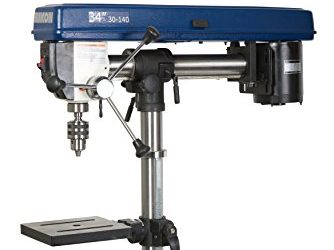
RIKON 30-140 34-Inch Radial Bench Drill Press

The RIKON 30-140 suits a home workshop where angled holes matter more than brute power, and where bench space is limited. Its telescopic head slides out to a 34-inch swing, and tilts 45 degrees right and 90 degrees left, so angled holes in stair parts, brackets and frames can be drilled with the workpiece flat and clamped. Five speeds from 620 to 3,100 RPM cover softwood, hardwood and light metal, and the MT-2 spindle taper allows quick changes between chuck arbors and end mill bits. The 1/3 HP motor is the lightest here, so it rewards patient feed rates and sharp bits rather than force.
Specs
- 1/3 HP motor
- 5 spindle speeds from 620 to 3,100 RPM
- 34-inch swing with a telescopic head that moves back and forth
- Head tilts 45 degrees right and 90 degrees left for angle drilling
- 5/8-inch chuck
- MT-2 spindle taper for quick changes from chuck arbors to end mill bits
- Two-year warranty
Best for: Angled holes and general precision drilling from a compact benchtop.
Watch out for: Confirm the 1/3 HP motor suits the thickest material you drill, and check the head lock holds firmly at full extension before boring.
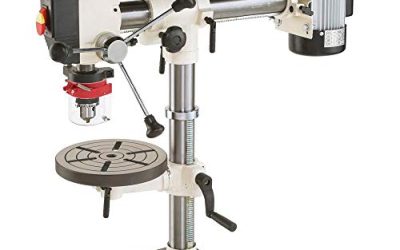
SHOP FOX W1669 1/2-Horsepower Benchtop Radial Drill Press

The SHOP FOX W1669 is the pick for a small bench that still needs floor-press reach, since it packs a 34-inch swing and a 1/2 HP motor into a machine only 31-1/2 inches tall. The radial head and tilting table work together, so angled holes can be set by moving the head or tilting the table, whichever keeps the workpiece better supported. Five speeds from 550 to 3,470 RPM handle large bits in steel at the slow end and small bits in softwood at the fast end. Its cast-iron base has mounting points for bolting down, which matters on a tall, head-heavy machine like this one.
Specs
- Motor: 1/2 HP, 110V, 5A
- Overall height: 31-1/2 inches
- Number of speeds: 5, from 550 to 3,470 RPM
- Drill chuck: 5/8 inch
- Spindle travel: 3-1/4 inches
- Swing: up to 34 inches
- Precision-ground cast iron table swings 360 degrees and tilts 90 degrees in both directions
Best for: Benchtop workshops that need long reach and angled drilling in a small footprint.
Watch out for: Bolt the base to the bench, since the heavy head can make the machine top-heavy when extended, and confirm the table tilt locks hold before drilling.
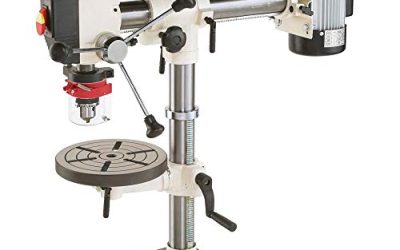
SHOP FOX W1670 1/2-Horsepower Floor Radial Drill Press

The SHOP FOX W1670 fits workshops where the press stands on the floor and the work comes to it, rather than the other way round. At 64-1/2 inches tall it suits standing work on tall pieces, long stock and assemblies that would never fit on a bench, and the radial head reaches over work set on the floor or a low support. It shares the W1669 motor, chuck, spindle travel and five speeds, so drilling capacity is familiar, while the floor stance adds stability for heavy pieces. The table tilts for angled holes, and the rack-and-pinion elevation control moves the table to the right height without wrestling the workpiece.
Specs
- Motor: 1/2 HP, 110V, 5A
- Overall height: 64-1/2 inches
- Number of speeds: 5, from 550 to 3,470 RPM
- Drill chuck: 5/8 inch
- Spindle travel: 3-1/4 inches
- Swing: up to 34 inches
- Radial arm drill press with head and table tilt for drilling at any angle
- Rack-and-pinion elevation controls
Best for: Standing work on tall, long or heavy pieces in a dedicated workshop space.
Watch out for: Measure the ceiling and floor space first, since the 64-1/2-inch height needs headroom above the machine, and confirm the floor is level before bolting it down.
Which One Fits Your Situation
Drilling the Centre of Wide Panels
When the hole sits in the middle of a wide panel, reach decides everything, and the WEN 4233 is the natural fit. Its head slides out to a 33-inch swing, so the chuck lands over the centre of stock that a fixed-column press cannot reach at all. The five speeds and the tilting table cover the rest of the job, from softwood panels to steel plate, without moving the workpiece mid-hole.
Angled Holes in a Small Workshop
For angled holes where bench space is tight, the RIKON 30-140 makes the most sense. The head tilts 45 degrees one way and 90 degrees the other, so the workpiece stays flat and clamped while the head takes the angle. Its benchtop size fits a small bench, and the five speeds handle the usual mix of wood and light metal in a home workshop.
A Shared Bench in a Home Workshop
If one bench serves every job, the SHOP FOX W1669 earns its place. It stands only 31-1/2 inches tall yet reaches a 34-inch swing, and the table swings a full circle and tilts both ways, so setups change quickly between jobs. The 1/2 HP motor copes with hardwood and thin steel, and bolting the base down keeps it steady on a bench that also holds other tools.
Standing Work Without a Bench
When pieces are too tall or too heavy for a bench, the SHOP FOX W1670 is the answer. Its floor stance and 64-1/2-inch height put the work at a comfortable standing height, and the radial head reaches over large assemblies set on the floor. The same 1/2 HP motor and five speeds as its benchtop sibling keep drilling capacity familiar while the stance does the heavy lifting.
Common Mistakes
- Buying on swing alone and ignoring spindle travel, so deep holes need the table moved mid-bore and end up stepped.
- Leaving the base unbolted, which lets a head-heavy radial press rock or tip when the arm is fully extended.
- Drilling steel at wood speeds, which overheats the bit, dulls its edge and leaves an oversized, rough hole.
- Holding the workpiece by hand instead of clamping it, so a grabbing bit spins the work and ruins the hole.
- Forgetting to remove the chuck key before switching on, which turns a small tool into a fast-moving hazard.
Frequently Asked Questions
What makes a radial drill press better for precision work on wide pieces?
A radial head slides and swivels along its arm, so the chuck reaches the centre of a wide panel without moving the workpiece. That keeps the work clamped and square to the bit through the whole cut, which is what holds a hole on its marked centre instead of drifting toward the edge.
How much swing do I need for precision drilling projects?
Measure the widest panel you drill and check that the swing covers half its width plus room for clamps. A swing of 33 to 34 inches suits most furniture panels and cabinet parts, while smaller work fits a shorter swing if the head still reaches the centre comfortably.
Can a radial drill press drill angled holes accurately?
Yes, when the head or table tilt locks firmly before drilling. Set the angle with a square or angle gauge, lock both the head and the table, and clamp the workpiece so it cannot shift. A loose tilt lock is the usual cause of angled holes that wander off their mark.
Do I need to bolt a radial drill press to the bench or floor?
Bolting down is strongly recommended for accurate work. A radial press is head-heavy at full extension, and even slight rocking shows up as an out-of-square hole. Use the mounting holes in the base, check the machine is level, and re-check the locks after moving the head.
More from Amazon
Programs that pair well with the guide above. Offers and eligibility are set by Amazon and may change.
Set up recurring deliveries of everyday items on eligible products. Terms and savings are set by Amazon.
Explore Subscribe & SaveCollect the home and kitchen items you want in one registry that guests can shop from.
Create a wedding registryFree shipping on eligible items, Prime Video and more. Eligible new members can start with a free trial.
Start a Prime free trialAudiobooks and podcasts to listen to on the go. Eligible new members can start with a free trial.
Try Audible freeAs an Amazon Associate we earn from qualifying purchases.
Write Your Review
No reviews yet. Be the first to share your experience!