

Key takeaways
- Find the right radial drill press for your equipment maintenance shop. Compare swing, spindle travel, speeds, chuck size and benchtop or floor fit.
A maintenance shop rarely drills holes in the middle of a small board. The work is usually a bulky housing, a long bracket, or a worn mounting plate that cannot be slid around a fixed column, and the hole often has to land off center or at an angle. That is the real decision behind a radial drill press: whether the head travels to the work instead of forcing the work to the spindle. Swing, spindle travel, and head tilt matter far more here than raw motor size, because reach and positioning decide which jobs the machine can take on at all.
This guide is for equipment maintenance shops, repair benches, and fabrication corners that need to drill, ream, and tap holes in awkward parts without a machine shop setup. The five presses below were chosen from product names and specifications listed on Amazon pages, favoring machines with a genuine sliding and tilting radial head, a usable range of speeds, and a chuck that accepts common maintenance bits.
Quick Picks
As an Amazon Associate we earn from qualifying purchases
| Product | Best for | Key spec |
|---|---|---|
| RIKON 30-140 Benchtop Radial Drill Press | Small repair benches needing angled holes | 34-inch swing, 5 speeds from 620 to 3,100 RPM |
| Shop Fox W1670 Floor Radial Drill Press | Floor-standing work on tall or heavy parts | 64-1/2-inch height, 3-1/4-inch spindle travel |
| Shop Fox W1669 Benchtop Radial Drill Press | Benchtop shops wanting deeper holes | 3-1/4-inch spindle travel, 5 speeds to 3,470 RPM |
| RIKON 30-251 Floor Radial Drill Press | Shops without a spare workbench | Floor-standing frame with a 34-inch swing |
| Palmgren 80341 Benchtop Radial Drill Press | Wide speed range for mixed metal and wood | 5 speeds from 575 to 3,520 RPM |
How to Choose
Swing and Reach
Swing tells you how wide a part the head can reach across, and on a radial press it changes as the head slides along the arm. A 34-inch swing sounds generous, but the useful number is the distance from the spindle to the column at the arm position you actually use. For maintenance work, measure your widest common parts first: pump housings, gearbox covers, and long mounting rails. If the head cannot slide far enough to center the spindle over the hole, the swing figure on the box will not help you.
Spindle Travel and Depth Control
Spindle travel is the distance the quill plunges in one stroke, and it decides whether a deep hole can be finished without resetting the table or the part. Short travel, such as the 3/8-inch stroke on some compact radial models, suits shallow holes in plate and brackets but struggles with deep bores and repeated counterboring. Look for a positive depth stop as well, because repeat holes in a batch of brackets need the same depth every time. A travel of 3-1/4 inches covers most maintenance drilling comfortably.
Speed Range and Material
Different materials and bit sizes need different spindle speeds, and a maintenance shop meets all of them in one week: slow speeds for large bits in steel, faster speeds for small bits in aluminum and wood. Five stepped speeds from roughly 550 to 3,500 RPM cover that range well, provided you are willing to move the belt between pulleys. Check that the lowest speed is genuinely low, because a press whose slowest setting still spins fast will burn bits and overheat holes in steel.
Benchtop or Floor Standing
A benchtop radial press keeps the machine close to hand tools and fits a crowded bench, but it needs a sturdy, level bench and eats space that other work could use. A floor model stands on its own, handles taller parts, and frees the bench, yet it demands floor space and a permanent spot near power. Decide from the parts you handle: if housings and frames arrive on a cart or the floor, a floor model saves lifting; if the work comes to the bench, a benchtop unit is the better fit.
The 5 Best Options
RIKON 30-140 Benchtop Radial Drill Press

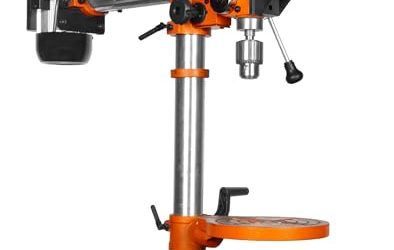
The RIKON 30-140 is the most compact radial press in this roundup, and it earns its place by doing the core radial job well on a bench. Its head slides back and forth for wide boards and housings, tilts 45 degrees to the right and 90 degrees to the left for angled holes, and the table rotates a full 360 degrees. Five speeds from 620 to 3,100 RPM handle wood and light metal, and the cast iron table gives a stable surface for clamped parts. It is a sensible pick when bench space is tight but reach still matters.
Specs
- Motor: 1/3 HP, 120V
- Swing: 34 inches
- Speeds: 5 speeds from 620 to 3,100 RPM
- Chuck size: 5/8 inch
- Spindle travel: 3/8 inch
- Head tilt: 45 degrees right, 90 degrees left
- Table: 7-3/4 by 7-3/4 inch cast iron, rotates 360 degrees
- Spindle taper: MT2
- Warranty: 2-year limited warranty
Best for: Small repair benches that need angled and off-center holes in wood and light metal.
Watch out for: The 3/8-inch spindle travel is short for deep holes, so check your deepest common bore before buying.
ASIN: B002FB74WY
Shop Fox W1670 Floor Radial Drill Press

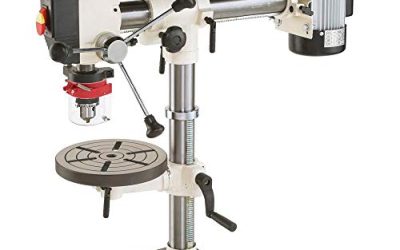
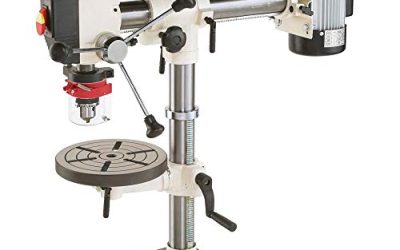
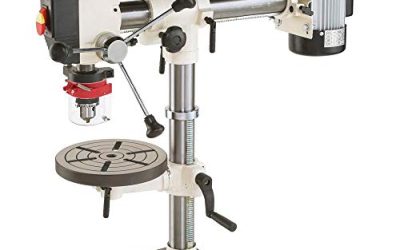
The Shop Fox W1670 takes the same radial idea and puts it on a floor-standing frame, which suits shops where parts arrive heavy and tall. Its head tilts for angled drilling, the table tilts 90 degrees in both directions and swings a full 360 degrees, and the 3-1/4-inch spindle travel handles deep holes without constant repositioning. Five speeds up to 3,470 RPM cover steel, aluminum, and wood with the right bit. The 64-1/2-inch height keeps the work at a comfortable standing level for long sessions.
Specs
- Motor: 1/2 HP, 110V, 5A
- Overall height: 64-1/2 inches
- Swing: 34 inches
- Speeds: 5 speeds from 550 to 3,470 RPM
- Chuck size: 5/8 inch
- Spindle travel: 3-1/4 inches
- Head tilt: 45 degrees left, 90 degrees right
- Table: Precision-ground cast iron, tilts 90 degrees both directions, swings 360 degrees
- Drilling capacity: 1/2 inch in wood and metal
Best for: Floor-standing maintenance work on tall, heavy, or bulky parts that are hard to lift onto a bench.
Watch out for: At 64-1/2 inches tall it needs a permanent floor spot, so measure ceiling clearance and walkway space first.
ASIN: B001R23SOU
Shop Fox W1669 Benchtop Radial Drill Press

The Shop Fox W1669 is the benchtop twin of the floor model above, keeping the same motor, speeds, and spindle travel in a machine that sits on a workbench. That combination is what makes it useful in a maintenance shop: the 3-1/4-inch spindle travel drills deep holes that the more compact radial presses cannot finish in one stroke, while the tilting head and 360-degree table handle angled work. Its 34-inch swing reaches across wide housings, and the cast iron base has mounts for bolting the press down solidly.
Specs
- Motor: 1/2 HP, 110V, 5A
- Overall height: 31-1/2 inches
- Swing: 34 inches
- Speeds: 5 speeds from 550 to 3,470 RPM
- Chuck size: 5/8 inch
- Spindle travel: 3-1/4 inches
- Head tilt: 45 degrees left, 90 degrees right
- Table: 9-3/4-inch diameter precision-ground cast iron, tilts 90 degrees both directions, swings 360 degrees
- Safety switch: Paddle switch with removable lock-out key
Best for: Benchtop shops that need deep holes and angled drilling without giving up a floor-standing footprint.
Watch out for: It has no built-in work light, so plan a bench lamp if you drill in a dim corner of the shop.
ASIN: B001R23SOA
RIKON 30-251 Floor Radial Drill Press

The RIKON 30-251 is the floor-standing version of the benchtop 30-140, built around the same head, speeds, and 34-inch swing. The difference is the frame: it stands on the shop floor, so no workbench is needed and taller parts can be set up at a comfortable height. The head still slides and tilts for angled holes, and the table rotates for positioning awkward pieces. It fits shops that like the 30-140 layout but have no spare bench or need the press beside other floor equipment.
Specs
- Motor: 1/3 HP, 120V
- Swing: 34 inches
- Speeds: 5 speeds up to 3,100 RPM
- Chuck size: 5/8 inch
- Head tilt: 45 degrees right, 90 degrees left
- Table: Cast iron, rotates 360 degrees
- Spindle taper: MT2
- Form: Floor-standing radial drill press
- Warranty: 2-year limited warranty
Best for: Shops without a spare workbench that still want the RIKON radial layout and reach.
Watch out for: The 1/3 HP motor is the lightest in this roundup, so keep to thin metal and wood rather than heavy steel plate.
ASIN: B002FB74XI
Palmgren 80341 Benchtop Radial Drill Press

The Palmgren 80341 is a benchtop radial press built for mixed material work, and its widest speed range is the reason to consider it. Five speeds from 575 to 3,520 RPM let the same machine run slow for steel and fast for wood and plastic, while the head moves 12 inches forward and backward on a rack and pinion and swivels a full 360 degrees around the column. The table tilts 45 degrees both ways and rotates as well, so angled holes in brackets and mounts are straightforward. Its cast iron base, worktable, and head keep vibration down during heavier cuts.
Specs
- Motor: 1/2 HP, 115V, 4.8A, 1,725 RPM
- Swing: 9 to 33 inches
- Speeds: 5 speeds from 575 to 3,520 RPM
- Chuck size: 5/8 inch keyed chuck, JT3 taper
- Spindle travel: 3.15 inches
- Spindle taper: MT2
- Head: Swivels 360 degrees, tilts 45 degrees both directions
- Table: Tilts 45 degrees both directions, rotates 360 degrees
- Weight: 100 lbs
Best for: Mixed-material maintenance work where the speed range matters as much as the radial reach.
Watch out for: The head rides on a rack and pinion, so confirm the slide locks firmly before drilling at full reach.
ASIN: B006JHLDL8
Which One Fits Your Situation
Your Bench Is Crowded and Parts Are Small
When bench space is the limiting factor and most jobs are brackets, plates, and small housings, the RIKON 30-140 fits best. Its compact frame leaves room for other bench tools, while the sliding head and 34-inch swing still reach across wider pieces when they appear. The 1/3 HP motor is adequate for wood and light metal, and the tilting head handles the angled holes that fixed presses force you to jig around.
You Drill Heavy Parts Standing Up
If housings, frames, and gearboxes arrive on a cart and are too heavy to lift onto a bench, the Shop Fox W1670 is the right choice. Its floor-standing height puts the work at standing level, the 3-1/4-inch spindle travel finishes deep holes in one stroke, and the tilting table handles angled setups. Give it a permanent spot near power and it becomes the default drilling station for the whole shop.
You Need Deep Holes on a Bench
When deep bores and counterbores are routine but floor space is not available, the Shop Fox W1669 solves the problem. It keeps the benchtop footprint while offering the same 3-1/4-inch spindle travel as its floor-standing sibling, plus a 5/8-inch chuck and five speeds to 3,470 RPM. Bolt the cast iron base to the bench and it stays steady through long drilling sessions on thick stock.
You Work Many Materials in One Week
Shops that move between steel brackets, aluminum housings, and wooden patterns in a single day should look at the Palmgren 80341. Its five speeds from 575 to 3,520 RPM give the widest range in this roundup, so large bits in steel run slow and small bits in wood run fast. The rack and pinion head travel and tilting table keep setup quick when the material changes from one job to the next.
Common Mistakes
- Buying on swing alone without checking how far the head actually slides at the arm position you use.
- Choosing a press with short spindle travel, then discovering deep holes need repeated table resets.
- Running steel at high speed because the belt was left on a wood setting, which burns bits and overheats the hole.
- Skipping the depth stop on repeat holes, so a batch of brackets ends up with uneven depths.
- Setting a benchtop press on a flimsy bench, where flex and vibration spoil hole accuracy and wear the machine.
Frequently Asked Questions
What makes a drill press radial?
A radial drill press has a head that slides along an arm and tilts, so the spindle moves to the hole instead of the part moving to the spindle. The head can also swivel around the column on many models. That reach and angle range is what separates a radial press from a fixed-column press, and it is why maintenance shops use them for bulky or awkward parts.
Can a radial drill press drill steel?
Yes, with the right speed and bit. Use the slowest speed for large bits in steel, keep the feed steady, and use cutting fluid where the material allows. A 1/2 HP motor handles plate and brackets well, while a 1/3 HP motor is better kept to thinner steel and lighter work. Always clamp the part firmly before starting the cut.
How much spindle travel do I need?
For most maintenance work, 3-1/4 inches of spindle travel is a comfortable minimum because it finishes deep holes and counterbores in one stroke. Short travel around 3/8 inch suits shallow holes in plate but forces repeated table adjustments on deeper bores. Match the travel to your deepest common hole, then add margin for the bit and the chuck.
Is a benchtop or floor radial press better for a maintenance shop?
It depends on how parts arrive. Benchtop models suit work that comes to the bench and shops short on floor space, while floor models suit heavy parts that stay on a cart or the floor. Both types in this guide share a 34-inch class swing, so choose by lifting and layout rather than by reach alone.
More from Amazon
Programs that pair well with the guide above. Offers and eligibility are set by Amazon and may change.
Set up recurring deliveries of everyday items on eligible products. Terms and savings are set by Amazon.
Explore Subscribe & SaveCollect the home and kitchen items you want in one registry that guests can shop from.
Create a wedding registryFree shipping on eligible items, Prime Video and more. Eligible new members can start with a free trial.
Start a Prime free trialAudiobooks and podcasts to listen to on the go. Eligible new members can start with a free trial.
Try Audible freeAs an Amazon Associate we earn from qualifying purchases.
Write Your Review
No reviews yet. Be the first to share your experience!