

Key takeaways
- Radial drill presses slide and tilt the head to reach holes a fixed head misses. Compare swing, throat reach, speeds and motors on the two worth buying.
A fixed-head drill press runs out of room the moment a hole lands more than a few inches from the edge of a board. Wide panels, cabinet sides and long rails all share the same problem: the column stands where the workpiece needs to be. A radial drill press answers that by moving the head instead of the work. The head slides along an arm toward or away from the column, swings around it, and tilts, so the spindle can reach the middle of stock that no ordinary press could touch.
That flexibility suits woodworkers drilling wide panels and angled balustrade holes, plus light metalwork on awkward brackets. Choice is genuinely narrow: only two radial presses are sold new on Amazon US with live listings right now, the benchtop and floor-standing Shop Fox models below, picked from their Amazon page names and specifications.
Quick Picks
As an Amazon Associate we earn from qualifying purchases
| Product | Best for | Key spec from title |
|---|---|---|
| SHOP FOX W1669 1/2-Horsepower Benchtop Radial Drill Press | Bench-mounted reach for wide panels | 1/2 HP motor |
| SHOP FOX W1670 1/2-Horsepower Floor Radial Drill Press | Floor-standing work on tall pieces | 1/2 HP motor |
How to Choose
Throat Capacity and Radial Reach
Swing is the headline number, but it only describes the widest circle the press can handle with the head at full extension. What matters day to day is throat depth: the distance from the column to the spindle centreline at the head position you actually use. Both presses here quote a 34-inch swing, meaning the head reaches about 17 inches out from the column. Measure your widest panel from its edge to the farthest hole, add clamping room, and buy reach beyond that figure rather than exactly at it.
Head and Table Movement
A radial head earns its keep through movement, so count the axes before buying. The head should slide along the arm, swivel around the column, and tilt for angled holes; on these Shop Fox models the head tilts 45 degrees left and 90 degrees right. The table matters just as much: a table that also tilts and swings lets you keep a heavy workpiece clamped once and bring the spindle to it, instead of re-clamping for every hole. Positive locks on every axis are essential, because an unlocked head drifts mid-cut.
Motor Size and Speed Range
Radial presses in this class run modest motors, and that is fine as long as expectations match. A 1/2 HP motor driving five belt speeds from 550 to 3,470 RPM covers small bits in wood at the top end and larger Forstner bits or holes in thin steel at the bottom. Low speed matters more than headline power: big-diameter bits need slow, steady torque, and a press that cannot slow down will scorch wood and dull cutters. Check the stated drilling capacity, here 1/2 inch in steel on the floor model, before planning heavy metal work.
Bench or Floor Footprint and Stability
Sliding the head outward shifts real weight away from the column, so stability deserves as much thought as capacity. A benchtop radial press must be bolted through its base to a stout bench, or it can feel tippy with the head extended and a panel hanging off the table. A floor model trades shop space for a lower centre of gravity and room to swing tall workpieces around the column. Measure ceiling height, floor space and the arc the table and head need before choosing between the two formats.
The 2 Best Options
SHOP FOX W1669 1/2-Horsepower Benchtop Radial Drill Press

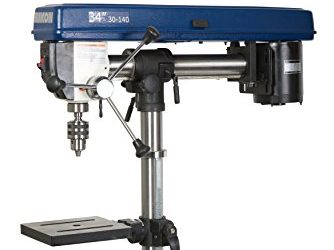
The SHOP FOX W1669 1/2-Horsepower Benchtop Radial Drill Press shrinks the radial layout onto a 31-1/2-inch frame that bolts to a workbench instead of claiming floor space. Its head slides in and out along the arm, putting the spindle over the middle of panels a fixed head could never reach, and the head tilts for angled holes in stair rails, frames and brackets. A 1/2 HP motor and five speeds suit wood and light metal, while the 5/8-inch chuck takes the larger bits this kind of reach is usually bought for.
Specs
- Motor: 1/2 HP, 110V, 5A
- Swing: 34 inches
- Spindle travel: 3-1/4 inches
- Speeds: 5, from 550 to 3,470 RPM
- Drill chuck: 5/8 inch
- Overall height: 31-1/2 inches
- Head and table tilt for drilling at an angle
Best for: Small shops that need radial reach on a bench, drilling wide panels and angled holes in rails and frames.
Watch out for: It must be bolted down securely; with the head fully extended, an unbolted bench press can feel top-heavy.
ASIN: B001R23SOA
SHOP FOX W1670 1/2-Horsepower Floor Radial Drill Press

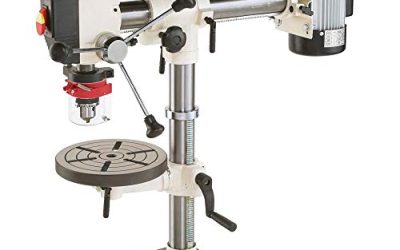
The SHOP FOX W1670 1/2-Horsepower Floor Radial Drill Press stretches the same radial design to a 64-1/2-inch floor-standing frame, which buys stability and room for tall workpieces that would hang awkwardly off a bench. The head slides, swivels and tilts 45 degrees left and 90 degrees right, and the table tilts 90 degrees in both directions and swings a full circle, so awkward parts can stay clamped while the spindle comes to them. Five speeds and a 5/8-inch chuck cover general wood and light metal drilling.
Specs
- Motor: 1/2 HP, 110V, 5A
- Swing: 34 inches
- Spindle travel: 3-1/4 inches
- Speeds: 5, from 550 to 3,470 RPM
- Drill chuck: 5/8 inch, 16 mm maximum
- Overall height: 64-1/2 inches
- Head tilts 45 degrees left and 90 degrees right
- Table tilts 90 degrees in both directions and swings 360 degrees
- Drilling capacity: 1/2 inch in wood and metal
Best for: Workshops with floor space that drill tall, wide or oddly shaped pieces and want the steadier stance of a standing machine.
Watch out for: The full-height column needs genuine floor space and headroom, and the 1/2 HP motor still limits it to light metal work.
ASIN: B001R23SOU
Which One Fits Your Situation
Your Bench Is the Only Space Available
Garages and spare-room shops rarely spare the floor area a standing press demands. The W1669 sits on the bench you already own, keeps the radial reach, and can share that bench with other tools between jobs. Bolt it down properly, leave clearance behind the bench for the head at full extension, and it handles the wide-panel work that pushed you toward a radial design in the first place.
You Drill Tall or Floor-Standing Work
Chair legs, cabinet carcasses and long rails behave badly perched on a benchtop table. The W1670 puts the table at a comfortable standing height and lets tall pieces rest against the column or reach the base for support. Its heavier stance also stays calmer with the head run out to full reach, which is exactly where a bench model feels least settled.
Angled Holes Are Your Main Reason for Buying
Stair balustrades, angled furniture joints and slanted bracket holes are where radial heads justify themselves. Either press tilts its head 45 degrees left and 90 degrees right, and the floor model adds a table that tilts 90 degrees both ways, so compound setups need fewer shims and re-clamps. If angled work is occasional, the benchtop tilt range already covers the common cases.
You Mostly Drill Small Parts
Be honest about the workload: if nearly every hole sits within a few inches of a board edge, a radial head adds setup fiddling you will rarely use. Between these two, the W1669 at short head extension behaves most like an ordinary bench press for small work, while still offering the reach on the days a wide panel or angled rail turns up.
Common Mistakes
- Judging a radial press by swing alone, without checking the throat depth at the head position where most of your work actually happens, and without confirming the table is big enough to support the panel while it overhangs.
- Setting a benchtop radial press on a bench without bolting it down, then extending the head fully with a heavy panel on the table and discovering the balance point the hard way, mid-project, with the workpiece already clamped in place.
- Moving the head or table between holes and forgetting to re-lock every single axis firmly, so the spindle quietly drifts off the marked centreline in the middle of the cut.
- Running large Forstner bits or hole saws at the fastest belt speed, which scorches wood, overheats the cutter, stalls a modest motor and leaves a rough, oversized hole that no amount of sanding will fully rescue afterwards.
- Expecting industrial radial-arm capacity from a light radial press; a 1/2 inch rating in steel is a ceiling to respect, not a challenge, and forcing bigger cutters through plate will only stall the motor, wander the hole and shorten the life of the spindle bearings.
Frequently Asked Questions
What makes a drill press radial?
On a conventional press the head is fixed to the column, so throat depth never changes. A radial model mounts the head on an arm it can slide along, and the head can also swivel around the column and tilt. Moving the spindle instead of the workpiece lets you drill far from a panel edge and at angles a fixed head cannot reach.
Is swing the same as throat depth?
No. Swing is twice the maximum distance from the column to the spindle centreline, so a 34-inch swing means roughly 17 inches of throat at full head extension. Throat depth shrinks as you slide the head inward, which is normal: you trade reach for rigidity on smaller work. Always compare the throat figure against the widest part you realistically plan to drill.
Can a radial drill press replace a standard press for everyday holes?
For most home-shop work, yes. With the head slid in and locked square, either model here drills ordinary holes much like a conventional press of the same motor size. The radial mechanism adds setup steps when you use its reach or tilt, and those extra joints demand a quick lock check, but nothing stops it serving as your only drill press.
How much motor does a radial drill press need?
For wood and light metal, the 1/2 HP motors fitted to both presses here are adequate, provided the speed range reaches low enough for large bits. Drilling capacity, stated as 1/2 inch in steel for the floor model, tells you more than horsepower alone. Regular work in thick steel belongs on a heavier industrial radial arm machine instead.
More from Amazon
Programs that pair well with the guide above. Offers and eligibility are set by Amazon and may change.
Set up recurring deliveries of everyday items on eligible products. Terms and savings are set by Amazon.
Explore Subscribe & SaveCollect the home and kitchen items you want in one registry that guests can shop from.
Create a wedding registryFree shipping on eligible items, Prime Video and more. Eligible new members can start with a free trial.
Start a Prime free trialAudiobooks and podcasts to listen to on the go. Eligible new members can start with a free trial.
Try Audible freeAs an Amazon Associate we earn from qualifying purchases.
Write Your Review
No reviews yet. Be the first to share your experience!