

Key takeaways
- Best radial drill presses for home workshops compared: sliding-head bench and floor models with up to 34 inches of swing for wide panels and angled holes.
As an Amazon Associate, we earn from qualifying purchases made through links on this page.
A radial drill press solves the one problem a fixed-column press cannot: reaching the middle of a wide board. On a standard press, the distance from the chuck to the column is fixed, so a tabletop, a wide shelf, or the center of a cabinet panel simply will not fit under the bit. On a radial model, the head slides in and out along a horizontal arm, so the throat depth changes to suit the work. The head also tilts, which lets you bore angled holes while the workpiece stays flat and clamped on the table.
One thing to know before you shop: the home-workshop radial market is genuinely small. Most drill presses sold today are fixed-column designs, and only a handful of true radial models are still in production for home shops. This guide covers the three current models that can actually be bought new through Amazon in the US — two from Shop Fox and one from Grizzly — and explains the differences that matter between them. All three share the same basic layout and a maximum swing of about 34 inches; they differ in footprint, speed range, and intended placement in the shop.
What to Look for in a Radial Drill Press
Swing and throat depth. Swing is twice the distance from the spindle center to the column, and on a radial press it is adjustable because the head slides along the arm. A 34-inch maximum swing means you can drill the center of a workpiece up to 34 inches wide. Check the minimum swing too: some radial heads cannot pull in as close as a small benchtop press, which matters for small parts.
Head tilt and table movement. The main reason to tilt the head instead of the table is control: the workpiece stays flat, clamped, and supported while the spindle does the angling. Look at how far the head tilts in each direction and whether the table also rotates and tilts for compound setups.
Speeds and how you change them. These machines use stepped pulleys, so changing speed means moving a belt under the top cover. Five speeds spanning roughly 550 to 3,470 RPM cover large bits in wood at the low end and small bits in metal at the high end. A chart inside the belt cover maps belt position to speed.
Chuck, spindle taper, and travel. A 5/8-inch keyed chuck is standard in this class and accepts bits with shanks up to 5/8 inch. Spindle travel around 3-1/4 inches lets you bore through thick stock in one stroke. A Morse taper spindle (MT2 on these models) also lets you swap the chuck for other taper-shank tooling.
Motor. Every current home-shop radial runs a motor around 1/2 HP on a standard household circuit. That is enough for wood and for light work in thin metal, but it is not an industrial machine: drilling capacity in steel is about 1/2 inch, and large Forstner bits in hardwood should be fed slowly.
Rigidity, the honest trade-off. A sliding, tilting head is more versatile and less rigid than a fixed column. At full arm extension the head can flex slightly under a heavy feed, so accuracy at maximum reach rewards a sharp bit, a slow feed, and letting the cutter do the work. If you never drill wide panels, a conventional press gives you more rigidity for the same money.
Bench or floor footprint. Benchtop radials still need a deep, sturdy bench — the arm overhangs the back when the head slides out — and they weigh close to 100 pounds. Floor models free up bench space and handle taller work between table and base, but they claim a permanent patch of floor.
The Best Radial Drill Presses for Home Workshops
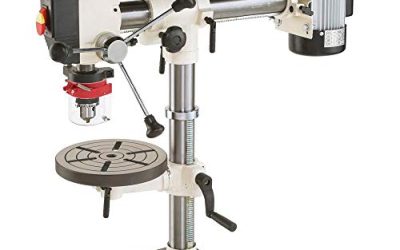
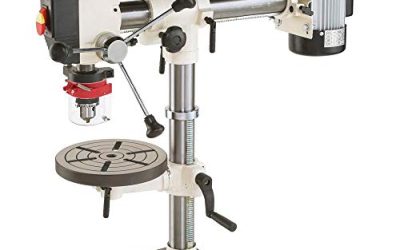
1. Shop Fox W1669 Benchtop Radial Drill Press — the bench-friendly pick

The W1669 puts the full radial layout on a bench. Its head slides along the arm for a swing that adjusts up to 34 inches, so it can bore the center of a wide panel that would stop an ordinary benchtop press cold, and the head tilts for angled holes in stair parts, chair work, and jigs. At 31-1/2 inches tall it fits under most wall cabinets, and the cast-iron base has slots for bolting it down, which a machine of this weight and reach really needs.
- ASIN: B001R23SOA — View on Amazon
- Motor: 1/2 HP, 110V, 5A
- Speeds: 5 speeds, 550–3,470 RPM (belt change)
- Swing: up to 34 inches (adjustable as the head slides)
- Chuck: 5/8-inch keyed
- Spindle travel: 3-1/4 inches
- Head tilt: 45 degrees one direction, 90 degrees the other
- Table: cast iron, tilts and rotates
- Overall height: 31-1/2 inches (benchtop)
Who it is for: woodworkers in a garage or basement shop who need panel reach but cannot give up floor space, and who drill wide tabletops, shelves, and casework more often than small parts.
Limitations to know: at full 34-inch extension the head is at its least rigid, so deep holes in hardwood at maximum reach need a light feed. The 1/2 HP motor is a wood and light-metal motor, not a production metalworking unit, and speed changes mean opening the cover and moving the belt.
2. Shop Fox W1670 Floor Radial Drill Press — the same reach, standing on its own

The W1670 is the floor-standing counterpart of the W1669, built around the same radial head, motor, and speed package but carried on a full-height column at 64-1/2 inches tall. Moving to a floor model changes how the machine fits your work more than how it drills: the table sits lower relative to tall workpieces, you can swing long boards around without a bench edge in the way, and the space between table and base accepts taller pieces than a benchtop can handle.
- ASIN: B001R23SOU — View on Amazon
- Motor: 1/2 HP, 110V, 5A
- Speeds: 5 speeds, 550–3,470 RPM (belt change)
- Swing: up to 34 inches (adjustable as the head slides)
- Chuck: 5/8-inch keyed
- Spindle travel: 3-1/4 inches
- Head tilt: 45 degrees one direction, 90 degrees the other
- Table: 12-1/4-inch cast iron, rotates 360 degrees and tilts
- Overall height: 64-1/2 inches (floor model)
Who it is for: home shops with a spare floor corner where the press can stay set up, especially for furniture work, longer stock, and taller assemblies that crowd a benchtop machine.
Limitations to know: the drilling package is identical in power to the benchtop version, so you are paying for placement and capacity around the table, not extra muscle. It is a tall, heavy machine to move and assemble, and the floor footprint is permanent in a small shop.
3. Grizzly G7946 34-Inch Floor Radial Drill Press — the Grizzly alternative

The G7946 is Grizzly’s entry in the same class: a floor-standing radial press with a 34-inch swing, a pivoting head for angled drilling, and a five-speed belt drive with a slightly lower top speed than the Shop Fox pair. It uses a JT33 chuck mount and a keyed chuck sized from 1/64 inch to 5/8 inch, and Grizzly rates its drilling capacity at 1/2 inch in steel. For a home shop already buying Grizzly machinery, it keeps parts and support under one roof.
- ASIN: B0000DD6TG — View on Amazon
- Motor: 1/2 HP, 120V, single-phase
- Speeds: 5 speeds, 550–3,000 RPM (belt change)
- Swing: 34 inches maximum (adjustable as the head slides)
- Chuck: JT33 keyed chuck, 1/64-inch to 5/8-inch capacity
- Drilling capacity: 1/2 inch in steel
- Design: floor model, radial arm with pivoting head
Who it is for: home machinists and woodworkers who want the floor-model radial layout from Grizzly’s catalog, and who mostly drill wood and light metal within a 3,000 RPM ceiling.
Limitations to know: the 3,000 RPM top speed is a little lower than the Shop Fox machines, which matters only for very small bits in metal. Published specifications for this model are thinner than the Shop Fox pair, so confirm table size and spindle travel against the current Grizzly listing before ordering if those numbers decide your purchase.
Comparison Table
| Feature | Shop Fox W1669 | Shop Fox W1670 | Grizzly G7946 |
|---|---|---|---|
| Type | Benchtop radial | Floor radial | Floor radial |
| Motor | 1/2 HP, 110V | 1/2 HP, 110V | 1/2 HP, 120V |
| Speeds | 5, 550–3,470 RPM | 5, 550–3,470 RPM | 5, 550–3,000 RPM |
| Maximum swing | 34 in | 34 in | 34 in |
| Chuck | 5/8 in keyed | 5/8 in keyed | 1/64–5/8 in keyed (JT33) |
| Spindle travel | 3-1/4 in | 3-1/4 in | See current listing |
| Head tilt | 45° / 90° | 45° / 90° | Pivoting head |
| Overall height | 31-1/2 in | 64-1/2 in | Floor model |
| ASIN | B001R23SOA | B001R23SOU | B0000DD6TG |
Frequently Asked Questions
What can a radial drill press do that a regular drill press cannot?
It moves the hole instead of the workpiece. Because the head slides along the arm, throat depth adjusts from close-in work out to the center of a panel up to 34 inches wide, and the tilting head bores angled holes while the part stays flat and clamped. A fixed-column press has one throat depth and angles only by tilting the table.
Is a radial drill press rigid enough for accurate work?
For wood and light metal at moderate reach, yes. Rigidity drops as the head slides farther out, so the most demanding cuts should be made closer to the column, with sharp bits and a controlled feed. If pinpoint repeatability in metal is the priority, a fixed-column press is the better tool.
Can these machines drill metal as well as wood?
Within their limits. The 1/2 HP motors, low starting speed around 550 RPM, and roughly 1/2-inch capacity in steel suit thin stock, brackets, and hobby machining. They are not substitutes for an industrial radial arm machine or a milling machine.
How much room does a radial drill press need?
More than its footprint suggests. The arm and head sweep behind and above the machine, the workpiece can extend well past the table on both sides, and a benchtop model needs a deep, rigid bench that can carry close to 100 pounds without flexing.
Why are there only three models in this guide?
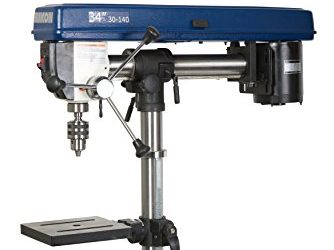
Because the category is that small. True radial drill presses for home workshops have mostly been replaced by fixed-column models, and several older radials, such as the Rikon 30-140, are no longer reliably in stock new. Rather than pad the list with standard presses, this guide covers only machines that are genuinely radial and currently sold.
Conclusion
For most home workshops, the Shop Fox W1669 is the practical default: it delivers the full radial advantage — adjustable reach out to a 34-inch swing and a tilting head — in a benchtop package that fits a garage shop. Choose the Shop Fox W1670 instead when you have the floor space and regularly work with taller pieces, since it drills identically but stands on its own column. The Grizzly G7946 is the alternative for buyers who prefer Grizzly’s catalog and support, accepting a slightly lower top speed. Whichever you pick, bolt it down, keep bits sharp, and make heavy cuts near the column — that is how a radial press earns its keep.
More from Amazon
Programs that pair well with the guide above. Offers and eligibility are set by Amazon and may change.
Set up recurring deliveries of everyday items on eligible products. Terms and savings are set by Amazon.
Explore Subscribe & SaveCollect the home and kitchen items you want in one registry that guests can shop from.
Create a wedding registryFree shipping on eligible items, Prime Video and more. Eligible new members can start with a free trial.
Start a Prime free trialAudiobooks and podcasts to listen to on the go. Eligible new members can start with a free trial.
Try Audible freeAs an Amazon Associate we earn from qualifying purchases.
Write Your Review
No reviews yet. Be the first to share your experience!